
The 3 Signals Your Nervous System Is Overloaded (And What To Do About Each One)
Quick Read: 6 minutes
What You'll Learn:
The 3 unmistakable signs your nervous system is in survival mode
Why "just relax" doesn't work (and what actually does)
How to recognise which signal you're experiencing right now
Specific protocols for each type of nervous system overload
When to be concerned vs. when it's manageable

It was one of those days…
It was one of those days.
Morning: I jumped out of my skin when my son said my name from behind me. My heart was racing, my hands were shaking. Over nothing.
Afternoon: I sat in a meeting unable to access words. My brain felt like it was moving through sludge. I nodded along, hoping no one would ask me a direct question because I genuinely couldn't form coherent thoughts.
Evening: Exhausted. Completely depleted. I could barely keep my eyes open through dinner. But when I got into bed? Mind racing. Heart pounding. Wide awake at 11pm, then again at 2am, then 4am.
Three different states. One day. All the same root cause.
My nervous system wasn't just stressed. It was overloaded.
The Difference Between Stressed and Overloaded
In last weeks’ blog we talked about why your stress tolerance shrinks during perimenopause—how declining oestrogen and progesterone remove your hormonal shock absorbers.
This week, we're going deeper: how to recognise when your nervous system has crossed from "stressed" (which is manageable) into "overloaded" (which requires intervention).
The difference matters because the solutions are different.
When you're stressed, self-care helps. A bath, a walk, a good night's sleep—these restore you.
When you're overloaded, your nervous system is stuck. It can't shift back to calm on its own. It needs specific tools to reset.
Understanding What's Actually Happening
Your nervous system has two main modes:
Sympathetic (fight/flight/freeze): Activated when there's a threat. Heart rate up, breathing shallow, muscles tense, digestion stops. You're ready to survive.
Parasympathetic (rest/digest/repair): Activated when you're safe. Heart rate normal, breathing deep, digestion working, body can heal and recover.
When you're healthy, you shift fluidly between these states. Stressful meeting? Sympathetic kicks in. Meeting over? Back to parasympathetic.
But when you're overloaded, you get stuck in sympathetic dominance.
Your nervous system treats EVERYTHING like a threat. Even neutral or positive things trigger the stress response.
Someone saying your name? Threat. An unexpected text? Threat. A minor schedule change? Threat.
Your nervous system's threat detection system—the amygdala—becomes hypersensitive. And during perimenopause, when oestrogen (which helps regulate this system) is declining, you shift into threat mode faster and stay there longer.
Your threat threshold drops. Smaller things trigger bigger responses.

The 3 Signals Your Nervous System Is Overloaded
Here's what nervous system overload actually looks like. You might experience one signal, or you might cycle through all three (often in the same day).
Signal 1: Hypervigilance & Hyperreactivity
What it looks like:
You startle easily. Noises make you jump. People approaching from behind make your heart race. Unexpected movement sends adrenaline through your system.
Small frustrations trigger disproportionate reactions. Someone cuts you off in traffic and you feel rage. A colleague's email tone sets you off. Your kid interrupts you and you snap.
You're constantly scanning for problems. What could go wrong? What needs to be handled? What's the next crisis? You can't relax even when objectively nothing is wrong.
Everything feels urgent and overwhelming. Your to-do list makes your chest tight. Your calendar makes you want to cry. One more thing and you'll break.
Physically: Heart racing, shallow breathing, tight chest, tense shoulders, clenched jaw, digestive issues.
What's happening biologically:
Your amygdala (threat detection center) is hypersensitive. Cortisol and adrenaline are chronically elevated. You're stuck in sympathetic overdrive—your body is constantly preparing for a threat that never comes.
During perimenopause, declining oestrogen makes this worse. Oestrogen helps modulate the stress response and supports the calming neurotransmitter GABA. Without it, your nervous system stays activated.
What actually helps:
Bilateral stimulation: Walking (left-right movement), tapping alternating knees, butterfly hug (cross arms and tap shoulders alternately). This engages both brain hemispheres and helps process the activation.
Grounding exercises: 5-4-3-2-1 technique. Name 5 things you can see, 4 you can touch, 3 you can hear, 2 you can smell, 1 you can taste. Brings you into present moment instead of threat scanning.
Box breathing: Inhale 4 counts, hold 4, exhale 4, hold 4. Repeat for 5 minutes. Do this 2-3 times daily, especially before high-stress moments. Physiologically shifts you from sympathetic to parasympathetic.
Reduce actual threats: Limit news intake, reduce social media, avoid toxic people where possible. Your nervous system can't tell the difference between real and perceived threats—reduce both.
Co-regulation: Spend time with a calm person or pet. Nervous systems are contagious—being around calm helps you regulate.
What doesn't help:
"Just calm down" (your nervous system literally can't without tools). More intense exercise (adds more sympathetic activation). Pushing through (reinforces the threat response and deepens the pattern).

Signal 2: Shutdown & Disconnection
What it looks like:
You feel numb. Flat. Emotionally disconnected from everything and everyone.
Brain fog makes even simple decisions impossible. Should you reply to that email now or later? What should you make for dinner? The simplest questions feel overwhelming, and you just... can't.
You struggle to access words, thoughts, emotions. Someone asks how you're feeling and you genuinely don't know. Your internal experience feels muffled and distant.
You move through your day on autopilot. Going through the motions. Checking boxes. But not really present or engaged.
It feels like you're watching your life from outside your body. Like you're observing rather than participating.
Physically: Low energy, heavy limbs, difficulty motivating to do anything, wanting to sleep all the time.
What's happening biologically:
This is the freeze or collapse response—the third part of the stress response that people don't talk about enough.
After prolonged fight/flight (Signal 1), if the threat doesn't resolve, your nervous system gives up. It shifts into shutdown to conserve energy because it believes you can't win.
This often happens after weeks or months of hypervigilance. Your system is so depleted it collapses into shutdown.
What actually helps:
Gentle movement that reconnects you to your body: Slow walking, stretching, gentle yoga. Not intense—just enough to feel your body again.
Sensory reconnection: Splash cold water on your face, take a warm shower, touch different textures (soft blanket, rough bark, smooth stone). Brings you back into your body.
Small accomplishments: Make your bed. Complete one task. Rebuild your sense of agency with tiny wins. Your nervous system needs evidence that action leads to results.
Safe connection: Even just being in the same room as someone you trust. You don't have to talk. Proximity to safe humans helps shift the shutdown state.
Humming or singing: Stimulates the vagus nerve, which helps shift you from freeze to a more activated (but not hyperactivated) state.
What doesn't help:
Forcing productivity (deepens the shutdown). Judging yourself for being "lazy" (it's physiological, not motivational). Complete isolation (human connection, even passive, helps shift this state).
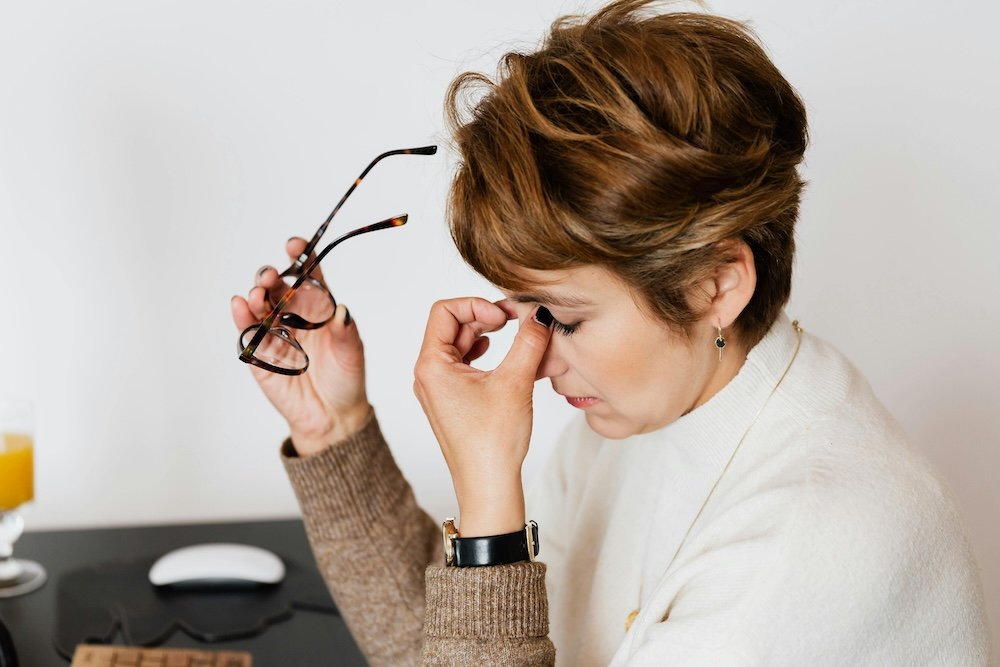
Signal 3: Wired & Tired (Simultaneously Exhausted & Unable to Rest)
What it looks like:
You're exhausted all day. Dragging through meetings, forcing yourself through tasks, desperately needing sleep.
But when you lie down at night? Your mind starts racing. Your to-do list. That conversation from three days ago. Everything you need to remember for tomorrow.
You can't fall asleep. Or you fall asleep and wake at 3am with your brain spinning and your heart racing.
You're simultaneously depleted and activated. Exhausted but wired. Can't sit still but have no energy. Want to rest but your body won't let you.
Physically: Bone-tired but heart racing. Desperately need a nap but can't fall asleep. Exhausted in the day, alert at night (completely backwards).
What's happening biologically:
Your cortisol rhythm is broken. Cortisol should be high in the morning (to wake you) and low at night (to let you sleep). But when you're overloaded, it stays elevated at night.
Your body is exhausted and depleted, but your nervous system won't allow rest because it still thinks there's a threat.
This is often Signal 1 (hyper vigilance) combined with complete resource depletion. You're running on fumes but can't refuel.
What actually helps:
Structured wind-down routine: Same time, same steps, every single night. Your nervous system needs predictability to feel safe enough to rest. 1 hour before bed: dim lights, no screens, calm activities only.
Magnesium glycinate: 300-400mg before bed. Supports nervous system calming and helps cortisol regulation. (Check with your doctor first, especially if on medication.)
No screens 1 hour before bed: Blue light disrupts cortisol clearing and keeps your nervous system activated. Read a physical book, do gentle stretching, take a bath instead.
Brain dump journaling: 10 minutes before bed, write down everything your brain is trying to remember. Gets the mental load out of your head and onto paper.
Progressive muscle relaxation: Tense and release each muscle group from toes to head. Signals to your nervous system that it's safe to let go of the tension.
Cool, dark room: 18-20°C, blackout curtains or eye mask, white noise if needed. Darkness and coolness signal safety and rest to your nervous system.
What doesn't help:
Scrolling in bed to "wind down" (activates your nervous system more). Alcohol to relax (disrupts sleep architecture and worsens cortisol regulation). Trying to "force" sleep (creates performance anxiety that makes it worse).

How To Know Which Signal You're Experiencing (And What To Do First)
Quick self-assessment right now:
Rate yourself 0-10 on each signal:
Hypervigilance/Hyperreactivity: ____/10
Shutdown/Disconnection: ____/10
Wired & Tired: ____/10
Your highest score is what to address first.
Note: You might experience multiple signals. Often hyper-vigilance (Signal 1) leads to wired-tired (Signal 3), which can eventually crash into shutdown (Signal 2). This is your nervous system cycling through all available responses trying to manage the overwhelm.
The Foundational Protocol (Do This Regardless of Which Signal)
Before you layer in the specific protocols, these foundations are non-negotiable:
1. Sleep: 7-8 hours in bed, same schedule every night. Everything is harder with sleep deprivation.
2. Daily nervous system reset: 5-10 minutes of intentional regulation practice. Box breathing, grounding, gentle movement—pick one and do it consistently.
3. Reduce input: Less news, less social media, fewer decisions. Your nervous system is already overloaded—stop adding to the load.
4. Increase safety signals: Routine, predictability, connection with safe people. Your nervous system calms when it can predict what's coming.
Then layer in the specific protocol for your highest-scoring signal.
When To Be Concerned (And When To Get Professional Help)
This is normal perimenopause territory:
You experience one or two signals occasionally
You can use the tools to shift out of the state within hours or a day
It doesn't interfere with your ability to work, care for yourself, or maintain relationships
This needs professional support:
All three signals are constant and severe
You can't function at work or fulfil basic responsibilities at home
You're having thoughts of self-harm or feel completely hopeless
These tools aren't helping at all after 2-3 weeks of consistent practice
Who to see:
Your GP: Get hormone testing, thyroid screening, vitamin D and B12 levels checked. Rule out other medical causes of nervous system dysregulation.
Therapist specializing in nervous system work: Look for someone trained in somatic therapy, EMDR, polyvagal theory, or trauma-informed approaches.
HRT specialist: Hormone replacement therapy can significantly help nervous system regulation during perimenopause. Not everyone is a candidate, but it's worth exploring.
The Bottom Line
That day when I cycled through all three signals—jumpy in the morning, foggy by afternoon, wired-tired by evening—I finally understood.
This wasn't stress I could meditate away. This was nervous system overload that required specific interventions.
Once I started using the right tools for each signal, things shifted. Not overnight. But consistently, over weeks.
My nervous system learned it could relax. That everything wasn't a threat. That rest was safe.
Yours can too.
Not sure which signal you're experiencing most? My FREE Midlife Edge Audit includes a Nervous System Load assessment that shows you exactly where you are and what to address first.
[Download it here] and stop guessing what your nervous system needs.
Because understanding the signal is the first step to regulating the response.
And regulation? That's how you get your edge back.
Quick Answers to Your Burning Questions:
Q: Can you have all three signals at once? A: Yes, absolutely. Your nervous system can cycle through all three in a single day (like mine did) or you can experience elements of multiple signals simultaneously. Wired-tired (Signal 3) is actually a combination state already. If you're experiencing all three regularly, that's a sign you need both the foundational protocol AND professional support.
Q: How long does it take to regulate a dysregulated nervous system? A: It depends on how long you've been overloaded and how consistent you are with regulation practices. Acute overload (a few weeks) can shift in 1-2 weeks with daily practice. Chronic overload (months or years) takes longer—usually 4-8 weeks to see meaningful improvement, 3-6 months for full regulation. This isn't a quick fix. It's retraining your nervous system.
Q: Is this anxiety/depression or nervous system overload? How can I tell the difference? A: There's significant overlap, and they often co-exist. Nervous system overload can cause anxiety and depression. Anxiety and depression can dysregulate your nervous system. The key difference: nervous system tools (breathing, grounding, movement) should provide some relief within minutes to hours. If they don't help at all, or if you have persistent hopelessness, loss of interest in everything, or thoughts of self-harm, that's clinical anxiety/depression and needs professional treatment.
Q: What if these tools don't work for me? A: First, make sure you're doing them consistently (daily, for at least 2 weeks). One-off attempts won't retrain your nervous system. Second, make sure you're addressing the foundational pieces (sleep, reducing input, safety signals). If you've done both consistently for 3 weeks and see zero improvement, it's time for professional support. Some people need HRT, therapy, or medication—and that's completely valid.
Q: Do I need medication or can I fix this naturally? A: There's no shame in either approach. Some women regulate through lifestyle changes, nervous system practices, and possibly HRT. Others need anti-anxiety medication or antidepressants, especially if there's underlying anxiety or depression. How I approach it is that I start with trying to work with my body. If after that consistent approach I’m still seeing issues, then I ask for help with doctors. It’s not an either or. The only thing I see often is women not understanding how to work with their body and feeling the only option is medication. It may not be.
Q: Will this get better after menopause? A: Often, yes. Once hormones stabilise at their new post-menopausal baseline (even though it's lower than before), many women find their nervous system regulation improves. The wild fluctuations of perimenopause are often harder than the stable-but-lower hormones of post-menopause. But this requires actively regulating your nervous system through the transition—not just white-knuckling through and hoping it resolves on its own.
Put the mask on you first, understand if your nervous system is overloaded and thrive again!
Want more evidence-based perimenopause and menopause advice straight to your inbox?
Subscribe below and get my FREE Top Sleep Tips for Women in Menopause PDF.